
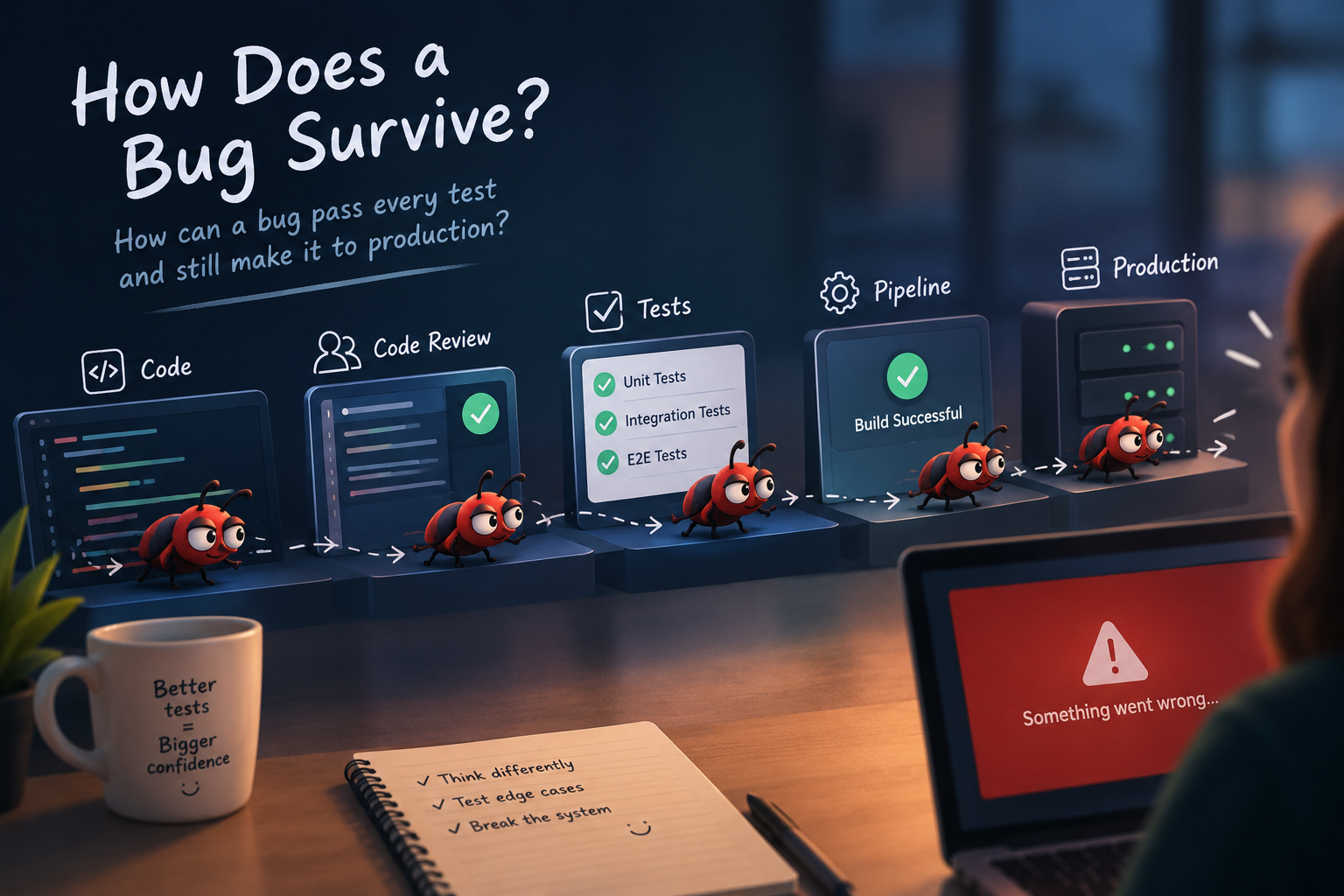
A bug doesn't always need bad code to reach production.
In fact, some bugs silently pass through a process where everyone is doing the right thing.
A developer writes the code.
The code is reviewed.
The tests are run.
The pipeline is green.
Everything seems fine.
Then the user comes along and disrupts the system. :)
So, how does the bug get here?
Because successful tests don't mean that a system is error-free.
A test only checks the scenario it was designed to test. If a bug exists in an unexpected scenario, the test naturally can't catch it.
For example, let's consider a payment system.
Our test might check something like this:
The user makes the payment → the payment is successful → the order is created.
Everything passes.
But what happens if a real user presses the payment button twice?
This is where a bug can survive.
That's why a good test engineer doesn't just ask:
"Does this work?"
There is a more important question:
"How can I break this?"
Because a good test focuses less on proving that the system is working correctly and more on finding where it might go wrong.
Maybe a bug's greatest talent isn't making a mistake; it's hiding where no one is looking for it.
Comments
Please log in to leave a comment.